
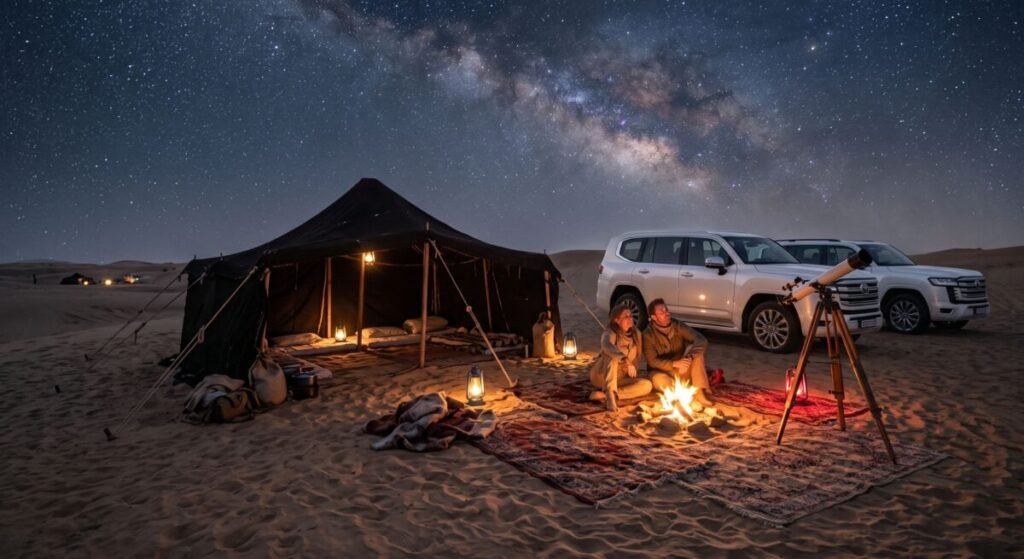
Overnight Desert Safari in Dubai : Stargazing, Glamping, and Bedouin Heritage
The Arabian Desert covers roughly 900,000 square miles across the Arabian Peninsula. While daytime tours offer a brief glimpse into its red dunes and arid terrain, the landscape transforms fundamentally after sunset. An overnight desert safari extends beyond standard day trips, allowing travelers to experience the drop in desert temperatures, near-zero light pollution, nocturnal ecology, and centuries-old Bedouin traditions.
This comprehensive guide provides an objective breakdown of what an overnight desert expedition in Dubai entails, covering desert ecology, historical Bedouin customs, glamping accommodations, stargazing mechanics, and practical field advice on behalf of Kazdoora Tours.
1. The Desert Landscape and Wildlife Ecology
Dubai’s desert safaris operate primarily across two distinct zones: the deep red sands of Lahbab near the Oman border, known for high slip-face dunes, and protected regions such as the Dubai Desert Conservation Reserve (DDCR) and the Al Marmoom Desert Conservation Reserve.
Category | Flora / Fauna | Adaptation & Significance |
|---|---|---|
Flora | Ghaf Tree (Prosopis cineraria) | UAE national tree; taproots extend down to 30m to tap deep aquifers and stabilize dune systems. |
Flora | Desert Hyacinth & Halophytes | Salt-tolerant succulent vegetation providing essential soil binding and seasonal grazing. |
Fauna | Arabian Oryx (Oryx leucoryx) | White reflective coat dissipates heat; wide hooves enable efficient locomotion across shifting sands. |
Fauna | Arabian & Sand Gazelles | Highly efficient water-retention physiology; active primarily during crepuscular dawn and dusk hours. |
Fauna | Nocturnal Species | Lesser Egyptian jerboas, Rueppell’s foxes, and desert geckos emerge after ground heat subsides. |
2. Bedouin Heritage and Camp Culture
Nomadic Arab pastoralists, known historically as the Bedouin (Bedu), inhabited the interior desert for millennia, relying on deep knowledge of water tables, stellar navigation, and seasonal grazing tracks. Authentic overnight camps incorporate core cultural practices:
- Hospitality Protocol (Dhiyafa): Guests are traditionally received with warmGahwa (Arabic coffee infused with cardamom and saffron) poured from a long-spoutedDallah pot into handleless ceramic cups (finjan), accompanied by local dates and rosewater hand-cleansing.
- Subterranean Cooking (Zarb): Marinated meats and root vegetables are placed on stacked tiers and lowered into an airtight pit dug directly into the sand containing acacia or ghaf charcoal. Sealed beneath sand for 3 to 4 hours, this method produces tender slow-roasted meat while conserving heat and moisture.
- Artisanal Breadmaking: Unleavened flatbreads, notablyRagag andKhameer, are stretched thin and cooked over a domed cast-iron hot plate (Saj), typically served immediately with honey, cheese, or date syrup.
- Falconry Heritage: Trapped during winter migrations, Saker and Peregrine falcons were historically conditioned to hunt hares and Houbara bustards. Camps feature traditional handling demonstrations demonstrating theTelwah (feathered lure) retrieval system.
3. Timeline of an Overnight Desert Safari
An overnight safari spans approximately 18 hours from mid-afternoon pick-up to mid-morning departure the following day.
Time Window | Phase | Primary Activities & Operations |
|---|---|---|
03:00 PM – 04:00 PM | Departure & Arrival | 4×4 transfer from urban Dubai; deflation of tire pressure to 12–15 PSI at the desert staging zone. |
04:15 PM – 05:30 PM | Dune Traversal & Sunset | Controlled dune navigation; ridge-top stop for sunset photography and sandboarding. |
05:45 PM – 07:00 PM | Settlement & Welcome | Camp registration, tent allocation, Gahwa service, and camel handling. |
07:00 PM – 09:30 PM | Dinner & Presentations | Barbecue and Zarb dinner buffet; acoustic Oud performance and Tanoura whirling display. |
10:00 PM – 11:30 PM | Night Sky Observation | Day visitors depart; generator illumination extinguished for night sky viewing and telescope sessions. |
11:30 PM – 05:30 AM | Overnight Rest | Overnight stay in private glamping dome or traditional canvas accommodation. |
05:30 AM – 07:00 AM | Sunrise & Breakfast | Early morning ridge walk for sunrise; hot breakfast with fresh bread, eggs, and Arabic tea. |
08:30 AM – 09:30 AM | Return Departure | Tire re-inflation at desert perimeter; highway transit back to Dubai city center. |
4. Accommodation Styles: Glamping vs. Traditional Stays
Overnight desert lodgings differ significantly across structural materials, thermal insulation, and private amenities:
Accommodation Type | Construction & Layout | Climate Control | Sanitation Facilities |
|---|---|---|---|
Traditional Canvas Tent | Heavy-duty woven canvas with interiorSadu geometric patterns; raised wood-frame beds. | Passive mesh ventilation; thermal wool blankets. | Centralized, permanent shared ablution block with hot showers. |
Heritage Stone Dwelling | Reconstructed clay-and-stone masonry reflecting historical eastern UAE desert dwellings. | High thermal mass regulates interior ambient temperature naturally. | En-suite or dedicated private adjacent bathroom. |
Geodesic Glamping Dome | Hard-shell geodesic framework with insulated walls and clear panoramic sky windows. | Split-unit active heating and air conditioning; insulated sub-flooring. | Full private en-suite bathroom with flushing toilet, vanity, and hot shower. |
5. Stargazing and Desert Astronomy
The Arabian Desert interior offers minimal artificial light pollution (Bortle Class 3 to 4 in designated reserves) and low relative humidity, establishing optimal atmospheric seeing conditions.
Historical Bedouin Navigation
Before modern GPS or compasses, desert caravans navigated solely by stellar markers:
- Polaris (Al-Qutb): Used as a permanent true north reference point for nocturnal travel across trackless sands.
- Canopus (Suhail): The seasonal appearance of the giant star Suhail in late August indicated the end of extreme summer temperatures and heralded the seasonal agricultural and nomadic pastoral calendar.
Astronomical Targets by Season
- Winter (November – March): Prominent visibility of the Orion constellation, the Great Orion Nebula (M42), the Pleiades (M45) open star cluster, and Sirius.
- Summer (May – September): Direct viewing of the dense galactic center of the Milky Way spanning through Scorpius and Sagittarius.
- Planetary Observation: Mid-sized portable Dobsonian telescopes (8-inch to 10-inch apertures) routinely resolve Jupiter’s equatorial cloud bands and four Galilean satellites, as well as Saturn’s Cassini Division.
Scheduling Note: For maximum deep-sky observation fidelity, schedule trips within three nights on either side of the New Moon. Full Moon phases increase desert floor illumination but wash out fainter nebulae and galaxies.
6. Climate and Diurnal Temperature Fluctuations
The desert environment features significant diurnal temperature swings due to dry atmospheric conditions and low thermal inertia of quartz sand:
- Winter Season (October – April): Daytime highs range between 24°C and 30°C (75°F–86°F), while overnight lows routinely drop to10°C to 14°C (50°F–57°F), occasionally lower in low-lying dune basins. Morning dew is common.
- Summer Season (May – September): Daytime highs frequently exceed 42°C (108°F), tapering to26°C to 30°C (79°F–86°F) at night. Stays during this period rely on active climate-controlled accommodations.
7. Practical Preparation and Field Guidelines
Proper preparation ensures a smooth and safe overnight desert stay:
Recommended Equipment & Attire
- Layered Wardrobe: Breathable, loose-fitting linen/cotton clothing for daylight; windproof fleece or light insulated down jacket for nocturnal temperature drops.
- Footwear: Closed-toe trail shoes or boots for traversing dunes; slip-on sandals for interior camp areas.
- Independent Power: Dedicated portable power bank (10,000–20,000 mAh), as standard camp generators are turned off late at night to ensure quiet hours.
- Optics & Astrophotography: 7×50 or 10×50 wide-angle binoculars; DSLR/mirrorless camera with wide-angle lens (f/1.8–f/2.8 aperture) and a compact travel tripod for long-exposure imaging.
Conservation & Safety Protocols
- Leave No Trace: Ensure all inorganic waste, plastics, and paper items are fully collected and disposed of in camp receptacles.
- Preserve Night Vision: Utilize red-filtered headlamps or torches in the stargazing perimeter to maintain ocular dark adaptation.
- Wildlife Boundaries: Maintain a minimum distance from wild gazelles, oryx, and foxes. Never introduce human food scraps into native wildlife habitats.
- Perimeter Awareness: Avoid unguided nocturnal walks beyond camp boundary markers to avoid disorientation on unmarked dunes.